Showing posts with label prayer. Show all posts

Wednesday, 15 August 2018

Stones in the Road (With Apologies to Mary Chapin Carpenter)

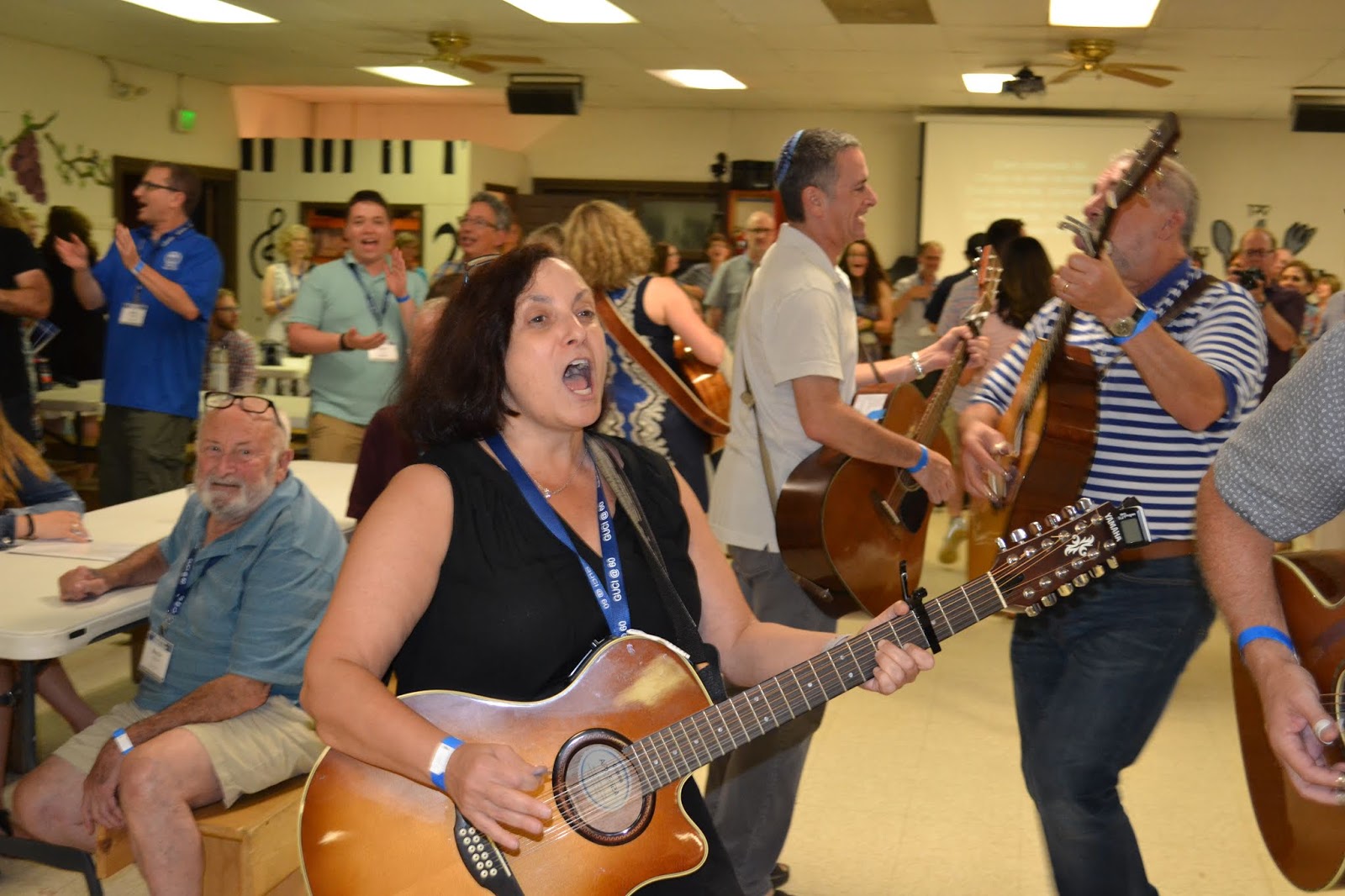
Last Shabbat morning, I had an opportunity to walk a familiar path at GUCI. It is a stroll I have taken hundreds if not thousands of times over the years. I shlepped my guitar along that well-worn gravel road that leads from the Chadar Ochel to the Beit T'fillah in order to prepare for services. But, what made this particular saunter unique is that it was the only time during the reunion weekend that I found myself completely alone.

It was a moment I used for some reflection. I wanted to take in the experience; to feel the stones in the road beneath my sandals, to smell the acrid August morning air. You see, when one reaches a certain point in life, the importance of such memories takes on a sense of deep and compelling urgency. I didn't want to forget anything about this place. This was the place of my youth. This was the place of my faith. This was the place of my deepest and oldest friendships. This was the place of decency. This was the place of true love.

As I trudged down that road, I could clearly recall the faces of hundreds, no...thousands, of campers and staff that had shared this sacred space with me in decades past. They were the pictures of tanned youth and sinewed strength. They had dreams and plans and hopes and ambitions. We were just coming into our own and the world would be stunned by our radiance. We rebounded from our disappointments far more gracefully and we hid our cynicism far more easily. We were idealistic and foolish in a way that only youth can forgive. Time was our ally and we had no thoughts of its fleeting.

I became acutely aware of the memories that each of the four-hundred of us has; those of us who made the pilgrimage back to this blessed, steamy cow-patch in weirdly but aptly Jewishly named, Zionsville. Each of us sharing those memories with others until the incomplete individual became the collective whole. A patchwork quilt of recollections woven together by laughter and prayer. It brought the holiness of this place into better focus for me.

As I came into the Beit T'fillah, I heard the din of conversations. People simply could not stop talking and sharing. I tuned my guitar and started to play the music of Shabbat morning with song leaders of my son's generation. We had only met the night before and had no idea if or how we might fit together but the sanctity of the space elevated our voices in perfect harmony. We all inherently understood how to do this because this is where we were tutored.


There is so much emotion wrapped up in a trip of forty-eight hours. It wasn't nearly long enough and yet it was perfection. I rediscovered a purity in my Judaism that had been sorely lacking lately. I heard The Divine Spirit whisper to me in the strings of a plucked banjo and I tasted Her kiss in the treacly Shabbos kugel. I sang until my lungs burned and I played until my fingers bled. I was more engaged in my faith during those two days than I have been in the past two years. This is the magic of Goldman Union Camp and it is a magic that every single one of the four hundred inherently understands. We are all just stones in the road of this place and for one weekend, we all came home.



Sunday, 2 October 2016

Shana Tova

I have been giving quite a bit of thought over the last week to the upcoming Yamim Noraim (The Jewish High Holy Days) and what it means for people of faith and for people who are questioning. This season is a time of reflection for Jews around the world, and while many of us look inward in order to find a sense of purpose and meaning for our lives, others choose to take a more arms-length approach to self-examination.

But here's the thing.

In whatever manner we choose to observe these sacred days, we need to be less critical of those who do not do as we ourselves might do and those who do not believe as we ourselves might believe. We are a fragmented people, us Jews. Some will attend synagogue this week and next and some may not. Some may have family dinners or break fasts and some may choose to eat alone. Some may pray and some may abstain. Some may be altogether uncomfortable with the notion of God and some may actively attempt to summon a Divine Spirit. Some may hopefully seek to right their wrongs and some may not believe that there are wrongs that need to be righted.

After spending a career trying to understand community needs and responses for these days, I have finally come to the conclusion that there is no cookie-cutter approach that will work. We as a people must seek to discover and actively maintain a sensitivity for those who have become disenfranchised by the product our organized religion has been selling. There is a reason that putting "Jews in the pews" has become so challenging and most of it stems from our lack of listening to those concerns. So, in order to start the new year off with some much-required balance, I offer a few tips for all of us observing over the next ten days. Hopefully, we can put these days into their proper perspective.

For those attending synagogue.

1) Stop worrying about what the people next to you are wearing. This is supposed to be the time when judgement should come from a higher place and not you. Are my prayers any less worthy if I choose to wear jeans? What matters is what is in the vessel, not the vessel itself.
Once Rabbi Elazar son of R. Shimon was coming from Migdal Gedor, from the house of his teacher. He rode along the riverside on his donkey, and was feeling happy and elated because he had studied much Torah.
 There chanced to meet him an exceedingly ugly man, who greeted him, "Peace be upon you, my master!" R. Elazar did not return his salutation but instead said to him, "How ugly this person is! Are all the people of your city as ugly as you?"
"I do not know," said the man. "But go to the craftsman who made me, and say to him: How ugly is the vessel which you have made!"
Realizing that he had done wrong, R. Elazar dismounted from his donkey, prostrated himself before the man, and said to him, "You are right. Forgive me!" But the man replied, "I will not forgive you until you go to the craftsman who made me and say to him, 'How ugly is the vessel which you have made.'" (Talmud Taanit 20a-b)
2) Don't search for fault in the rabbi's sermon and stop with the critiques. You may not always agree with what she/he has to say, but understand that great thought and care went into those remarks. Try and find the meaning beneath the surface.

3) Don't be so caught up in your own experience that you neglect the stranger or the newcomer. Find that person and invite them to sit with you. Synagogues can be giant cliques. Seek out the new person. We make new members when old members remember what it was like to be new.

4) Take five minutes during the service, any five minutes, and close your eyes. Breathe deeply. Listen to your own voice, your own thoughts. Try and remember why you decided to come. Make this place your holy place. You have to do the work if you want the results.

5) Stop looking around for who isn't there and focus on who is. Other people's decisions should have no bearing on your own. Remember that repentance, prayer, and charity temper judgement's severe decree.

For those who gather outside the synagogue.

1) Try and remember that there are reasons for these days that don't only involve food. Have some serious discussions at your tables about the themes and realities of the Yamim Noraim. Jews around the world are facing some difficult realities today. Let's not whitewash them with honey cakes and gefilte fish.

2) Add one extra ritual to your tables. Maybe it is some environmental experience for the "Birthday of the World" or maybe it is simply lighting festival candles that you haven't in years. Let the youngest amongst you hear and try to blow the Shofar. Do something to make the experience more than just dinner.

3) Make an effort to understand why some members choose to go to synagogue instead of gathering for dinner. Their feelings and beliefs matter too.

4) Don't dismiss religious observance as fantasy or fairy-tale. We who find meaning in it have our reasons for prayer, just like those who have no use for it have theirs. We need to respect each other's choices.

And to those who won't be doing anything during these days.

We will miss you. This is a time when all Jews can hopefully find some common ground for our concerns and our experiences. If this is not the year for you to rejoin us, then maybe next year will be. We just want you to know that you are always welcome. We are your people.

Shana Tova U'Metukah. I wish everybody a happy, a healthy, and a peaceful New Year. May we write our own stories and our own pathways, whatever they may be, in the Book of Life. 


Friday, 3 June 2016

Esa Einai

Esa einai el heharim, 
me'ayin yavo ezri

I will lift up my eyes to the mountains.
From where does my help come?  

Ezri me'im Adonai, 
Oseh shamayim va'aretz 

My help comes from Adonai, 
who made heaven and earth.  (Psalm 121)


I spent a huge chunk of my time today believing that I was staring into the face of the Almighty.

How could one feel anything less when gazing upon the majesty that is the Rocky Mountains from the summit of Sulfur Mountain in Banff Alberta?

God exists for me here because here I feel the natural presence of creation. Here I feel the need to utter words of thanks and prayer for the simple beauty that comes with the wholesome, the unrefined, the organic. Here I remember the music of benediction, the rhythm of invocation, the beat of devotion.

I will lift up my eyes to the mountains....

Today on the top of a mountain I saw God.

From where does my help come?

Today on the top of a mountain I felt spiritual strength manifest into physical strength.

My help comes from Adonai,

Today on the top of a mountain I knew unequivocally that I was not alone.

Who made heaven and earth.

Today on the top of a mountain I saw heaven and earth touch and together become infused with an intense spirit of holiness.

God walked with me today and I felt invigorated.


Wednesday, 2 September 2015

Can I Be a Fully Religious Jew Without Communal Prayer?

I am temporarily interrupting this month of Elul blogs to engage in what I hope will be an honest and frank discussion.

My mother and I had a conversation last week that was, at its core, about the annual observance of the Yamim  Noraim (High Holy Days)-family dinners, service times, clothing options. But it truly evolved into a discourse about the changing nature of our congregations, the content found within those walls, and whether or not a questioning but highly rational, scientifically-based individual can find value in prayer, or more specifically communal prayer. And are we, (I count myself amongst those who are questioning) best served by sitting for hours in a synagogue, simply flipping pages, during this holiest of times?

A few caveats before I delve further.

1. I am a retired cantorial soloist whose job it was for over thirty years to facilitate these services and communal prayer experiences. High Holy Days were the most stressful time of the year simply because we knew that our "audience" was at peak attendance and it was our opportunity to engage those wayward souls who honestly and accurately describe themselves as "twice a year Jews." I am not at all naive about what brings people into synagogues and what keeps them away. 

2. God does play a part in my life, but as I get older I have found myself engaged in a much more rational, intimate, and personal conversation with the Divine Presence and a far less spiritual one. 

3. I am not a liturgically-uneducated person. I have spent years studying and understanding our services, the Hebrew and English texts, the order of our worship, and why we do what we do when we do it. 

4. Judaism is a religion that is dependant upon communal involvement for the completion of many mitzvot. A minyan, or quorum of 10, is required for public prayer and finds its roots in both Torah and Talmud.

"And I shall be sanctified in the midst of the children of Israel" (Lev 22:32)
"Separate yourselves from the midst of the congregation" (Numbers 16:21)

Additionally we find in the story of the ten spies who returned with negative reports about the land, Moses complains to Aaron:

"How long shall I bear with this evil congregation which murmur against me?" (Numbers 14:27)

Using a biblical exegesis known as gezerah shavah, whereby two or more verses with similar terminology are compared, the Talmud (Megillah 23b) has deduced that the minyan is required for communal prayer. So, if a minyan is a religious commitment, and I wish to be a religious Jew, how can I fully justify a decision to disengage from public prayer, (attending services) that no longer carries any emotional weight or spiritual meaning?

And so begins our discussion....

Herein lies my fundamental problem: I am having trouble finding purpose or spiritual fulfillment in the majority of service experiences of late, and that includes many of the ones that I have led. I have been fortunate to hear wonderful compliments from congregants over the years as to how my music has moved them to a higher plane and aided in their spiritual journeys, but my own personal divine pilgrimage has been frustratingly stunted when it is within the confines of the synagogue walls and prayer books. I have worked with and been involved with some tremendously creative rabbis and cantors over the years who have been on the cutting edge of synagogue worship experiences, so I am not stuck in any kind of worship rut. I have tried the experimental, the experiential, the natural, the playing it straight, and the study. At best I find myself fidgeting, at worst I am bored and disinterested. It used to be that I would let the music carry me away, but lately I simply cannot get engaged in a service. I love the music of our people and am most moved when it is eclectic, but I am finding my voice is often silent these days during traditional worship experiences.

Last year, on the second day of Rosh Hashana, The Husband and I took a hike and communed with nature rather than attend services. We did tashlich, blew the shofar, ate some apples and honey, and enjoyed the warm autumn morning. It was the closest to God I had felt in many years and hopefully we will get a chance to repeat the experience.

So, what is the answer?

Frankly I am stumped. Is removing myself from communal prayer the answer? I'm not convinced because as Jews we not only require brethren, we welcome them, we envelop ourselves in group worship so that we might attain a level of kadosh, holiness. So...I am opening the floor to suggestions and discussion.


Monday, 31 August 2015

Blog Elul Day 16-Pray

"In prayer it is better to have a heart without words than words without a heart."~Mahatma Gandhi

I pray with full heart and full voice, but I continually question; what is the point of my prayer? Is it for me or is it about me? I worry that my sincerity has gone missing.

Keeping The Faith (2000)
Directed by: Edward Norton
Written by: Stuart Blumberg

**Blog Elul is the brainchild of Rabbi Phyllis Sommer. Her blog and various links can be found at http://imabima.blogspot.ca 
**We should always pray with joy like this. Music is the portal through which our prayers travel. For me..without music, prayer is meaningless.

Friday, 19 June 2015

When is Prayer Simply Not Enough?

I am tired of being told to pray.

Pray for the victims.

Pray for those affected by the violence.

Pray for the families and the mourners.

Pray for our leaders and our country.

Pray for peace.

Pray....

When is prayer simply not enough?

When it distracts from and obfuscates the real issues of institutional racism, gun violence, and domestic terrorism.

When it allows for an abdication of a collective call to action.

When it obscures our responsibilities to engage in Tikkun Olam, the reparation of our world.

When it tolerates an us versus them mentality.

When it gives leave for politics and ideology to stand in the way of logic and reason.

When it permits us to become immersed in what we think God wants instead of recognizing what people need.

By all means...pray. We all need it.

But it is simply not enough.


Tuesday, 25 November 2014

When Prayer is No Longer Easy

I used to get paid to pray.

I realize how utterly crass and unappetizing that must sound, and in truth it is a gross oversimplification of what my position as a cantorial soloist was all about, but there is some veracity in the statement. A huge chunk of the job description was all about leading the congregation in prayer, and I took tremendous pride in the sourcing of inspirational liturgical settings, as well as songs from outside of the synagogue, that would aid my community in the facilitation of their personal and collective davening. 

And yet....

Several years ago I began to feel like a fraud. My personal conversation with The Divine Spirit, which had always flowed so freely and unencumbered had, over time, become stale, stilted, and, so very gruelling. There was no specific incident that led to this frustration. No renaissance moment, no lightening bolt. It was a gradual process. The words on the page had become rote, and the music, in which I had previously taken so much comfort, began to seem ordinary and uninteresting. It felt like a huge part of the foundation on which I had built my entire life was crumbling, and I honestly had no idea how to deal with it.

There were times when I wished for atheism. I wondered if lack of belief was more liberating than my  personal struggles. But absence of faith was never my problem. Rather, I had become distressed that the old, comfortable ways of engaging had abandoned me. I questioned my spirituality. Oh, how I loathe that word. To me, it is a catchall phrase designed to offer deistic comfort where none exists, and it fails me miserably.  How could I be an effective leader of prayer if I simply couldn't find the will to engage in my own?

My recent retirement has afforded me some much needed time to ponder the dilemma. I have taken a step back from the established prayer service, and I have attempted to discover new and non-traditional ways to facilitate my personal dialogue with God. It has been frightening to abandon my comfort zone. When The Husband and I took one of the days of Rosh Hashana this year to hike through some trails near our home rather than attend synagogue, I will admit to some deep and profound feelings of guilt. (We Jews are nothing without a good dose of guilt.) But as we blew the shofar in the woods and performed our own personal tashlich (the ritual casting out of sins) in the Don River, I felt my personal connection with The Divine Spirit repair just a wee bit. I knew that God was there that day and we began the slow and painful process of reengaging our conversation.

And so, I will persist in my attempts to rediscover that which has been lost, to repair that which has been damaged, and I will continue the search for meaningful new prayer rituals.  They might include Shabbat walks on the beach when I head south, or they might involve some new practices in yoga or meditation. I haven't yet decided on the path, but I have the freedom now to experiment. I have, however, realized that my personal connection with God hasn't disappeared, it has merely been transformed. It is now up to me and my perseverance to enact the changes necessary to maintain the relationship. To me, it is one worth saving.

Kein Y'hi Ratzon. May this be God's will.


Tuesday, 4 November 2014

There Are Things....

As we move through these early days of November and I find myself becoming far more introspective as I attempt to come up with meaningful posts to feed the beast that is NaBloPoMo, I am struck by just how much has changed since I last attempted this gruelling task of 30 in 30.

There are definite touchstones in our lives; those moments that we recall with a maelstrom of emotion. They forever change us and alter the trajectory of our daily existence. 

This year alone I have danced at four weddings, including that of Younger Son and his Beshert, celebrated with three friends as they welcomed grandchildren, helped friends move from their house into a long-coveted condo, retired from my job/calling of twenty years, and I continue to grieve the loss of my Other Mother whose absence is still an enormous chasm I can't fully breach.

Twelve months. So much to digest. A roller coaster of emotional upheaval that is truly vertigo-worthy.

Every Shabbat in my synagogue we read the following passage from the Siddur (prayerbook).

The Talmud teaches: 

Elu Devarim She-ayn La-hem Shiur...These are the things that are limitless,
of which a person enjoys the fruit of the world, while the principal remains in the world to come. (Pe-ah 1:1)

(The Hebrew is actually a bit more extensive, but the gist is in this opening passage.)

A second teaching from Talmud is then conflated with the first.

They are:
honouring one’s father and mother,
engaging in deeds of compassion,
arriving early for study, morning and evening,
dealing graciously with guests, 
visiting the sick, 
providing for the wedding couple,
accompanying the dead for burial,
being devoted in prayer,
and making peace among people.
But the study of Torah encompasses them all. (Shabbat 127a)

I have always liked these words, mostly because they speak to the philosophical daily norms to which we should devote ourselves, but I have often been left wondering if I ever truly made the effort to really live them. This year, I feel as though I did. (I can almost place little check marks beside them all.)

My personal journey through Judaism, and faith in general, has been sorely tested over this past year. Prayer, which had always come so easily in the past, is now stunted and muted. But these words from Talmud have reminded me of what is really important; to live in the moment, be kind, remember that we aren't alone in our journey, and that there is always a foundation to fall back on. 

Believe me when I say, it helps.


Sunday, 3 November 2013

Women Of The Wall at 25

I am conflicted.

It isn't all that unusual.

When it comes to the state of Israel, conflicted is a kind expression of my emotions.

Don't get me wrong. I believe strongly in the existence of the state and in its unique position as a haven for Jewish life, thought, education, culture, prayer, and growth. Israel is and always should be.

But, I am also a realist and a progressive. As a Jewish woman and citizen of the Jewish diaspora, I feel it is imperative to challenge some of Israel's more disturbing and misogynistic policies. The fact of the matter is that there are still many ideas and regulations within the state that are anathema to me. It is amazing that for many, these abhorrent laws have crystallized around the Kotel (The Western Wall) and the fight for equal recognition of women's tefillah (prayer) by the advocacy group Women of the Wall.

For twenty-five years this dedicated group, encompassing religiously diverse women and many men who support them, have been gathering at the Wall every month to celebrate Rosh Chodesh, the new month. They come to the women's side of the mechitzah in order to pray their way; draped in tallitot (prayer shawls), covered in kippot, and ready to sing the prayers of Hallel. They read from the Torah and they celebrate as Miriam and the women did at the Sea. But, the orthodox rabbinate that controls the Wall and its plaza has become increasingly threatened by these women. They see them as an affront to all that they hold sacred, and have unleashed a torrent of hateful rhetoric upon them. These brave women have been catcalled. Epithets have been hurled in their direction while chairs, eggs and other projectiles thrown at them from the men's side. And when the abuse was at its very worst, they have been arrested, searched, relieved of their precious religious items, and held without charge. All because they wished to pray at Judaism's holiest site.

And through it all they have persisted. They have shown up every month, rain or shine, to daven. Lately, however their persistence has shown moderate signs of progress. The Knesset has been attempting to work out a compromise between WoW and the rabbis who oppose them. The battle is not yet over, but it does finally seem to be moving in a positive direction.

Today, as we prepare to welcome the new month of Kislev, the Women of the Wall are getting ready to celebrate their 25th anniversary. They will be commemorating this occasion in much the same way as they have every previous Rosh Chodesh over the past quarter of a century, with prayer and reverence at the Wall. I wish that I could be there to join them, but I hope that they take this meagre offering as a sign of my unwavering support and solidarity.

This prayer was written by Rabbi Sue Mauer Morningstar of Ashland Oregon.

To my dear Kotel sisters, on Rosh Chodesh Kislev, 5774,

Although I cannot be with you to celebrate our 25th anniversary, I send out this prayer and my love to you:

May the Holy One who blessed our ancestors Avraham and Sarah, Yitzchak and Rivkah, Yaakov and Leah, Rachael, Bilhah and Zilpah, bless all of the Nashot Hakotel and our supporters with strength, courage, perseverance and divine grace.  In the merit of our ancestors who sang out to God with their full beings in a strong voice, Miriam, Channah, Devorah, Serach bat Asher, the Shulamite and the women who came out to greet King David,  in the name of Michal, Bruriah and Rashi’s daughters,  in the memory of our Bubbies, many of whom were kept behind the mechitzah and out of cheders and yeshivot and colleges, and in humble recognition of our sisters in repressive religious regimes around the world today who are not free to sing out and to worship God in joy, may all women be free to worship God, each in her own way, because the time for silencing women is over!  “Shiru l’Adonai shir chadash!”, sing out to God a new song!

Amen, may it be so.


Friday, 2 November 2012

A Prayer

I am not much for inspirational quotes and sayings. We all know the type of which I speak. The stuff that regularly clogs up my Facebook timeline posted by well-meaning friends, but would better be off remaining in the belly of a fortune cookie. I am certainly not trying to belittle the good intentions behind these little nuggets of wisdom, but please understand that it takes more than a quotation pulled out of the ether to move me to reevaluate the course that my life is on. Those revelations and ass-kickings are usually provided by transformative events; sometimes those that are intensely personal and sometimes those viewed from a distance. Such were the effects of Hurricane Sandy.

We here in my area of The Great White North were also bombarded by the superstorm, but the aftereffects are not nearly to the extent of what our neighbours along the American Eastern Seaboard are attempting to deal with. We all are counting ourselves amongst the very fortunate as we clear our yards of debris all the while knowing that the damage to both life and property could have taken a far greater toll. We mourn with our friends who live in the direct path of Sandy's wrath, and we struggle to find meaningful ways to help. A donation to the Red Cross  is so vital, and yet it seems like so very little. 

All week I have struggled with the dichotomy that exists between the sense of relief that I feel for my own good fortune and the absolute helplessness I experience for those left in tatters. I have schizophrenically alternated between emotions of elation while marvelling at the leadership and cooperation being displayed by so many, and that of utter despair while sadly viewing those crying out in desperation. And while I am a firm believer that action must come first in these situations, I am never so self-centred as to believe that a prayer or two couldn't help the fallen. In my mind, prayers are the most personal of inspirational quotes. It is why I was so comforted when I received the following from the Union for Reform Judaism yesterday.

"We pray that those who suffer find comfort through their faith in You and through the loving kindness of those emergency workers and volunteers who have come to their aid.

We pray that those who have lost so much have the fortitude to rebuild their lives. Let us seek out ways to help them build their tents anew and make of them, once again, havens of healing and hospitality. May all who have been battered by this storm discover many hearts and hands open to them. None of us stands alone in times of trouble.

Baruch Atah, Adonai, magein Avraham v’ezrat Sarah.

Blessed are You, Adonai, shield of Abraham, help of Sarah.
 
Baruch Atah Adonai, ozer Yisrael b’guvrah:
Blessed are You, Adonai. You are the Source of our strength."

Allow me to add one more of my own. 

Blessed are You Adonai, who has shown us the power of nature. May we never again forget the delicate balance of the universe and our place within it.

Baruch Atah Adonai Eloheinu Melech Ha-Olam, Shenatan lanu hizdamnut l’takein et ha olam.
Blessed are You, Adonai, our God, Ruler of the universe, for giving us the opportunity to mend the world.

Shabbat Shalom to all who observe.

Sunday, 21 October 2012

A Funeral Code of Conduct

I attended at funeral today. It was heart-wrenching and brutal. Most funerals are. The deceased was a lovely woman who played an important role for The Husband during his formative years. She was a strong, fiercely independent, family-centred, caring, funny, and humane lady who, like many, suffered illness for too many years and died far too young. I liked her instantly from the day I met her, and my opinion of her did not waver in all these years. My guess is that the majority of the people in the crowd today felt as I did. And yet....one would be hard pressed to glean anything about this special human being from the service we collectively attended this afternoon. While her two sons recounted loving memories of their mother with grace and dignity, another so-called "family friend" had the crowd squirming in palpable discomfort as he selfishly prattled on with anecdotes about her late husband that barely involved the poor woman. He thought it funny to discuss pornography, misogynistic girl-chasing, told off-colour jokes, and did all of this without any notes or preparation. It was the capper to an hour long service that dishonoured a wonderful woman.

It is one of the most unfortunate duties of my work to attend and officiate at funerals. I have seen a great deal over the course of my career and I am usually loathe to criticize. Dealing with and comforting mourners offers a unique window into the human psyche, and what might work as words and acts of comfort for one, may not suffice for others. In short, everybody grieves differently and far be it from me to tell anybody how best to fathom a loss in often unfathomable circumstances. That said, I do believe that we have become extraordinarily lackadaisical in what might be considered appropriate funeral behaviour. It isn't as though I am asking for wailing, rending of garments, and sackcloth and ashes, nor am I suggesting that laughter at a funeral is inappropriate, but I am calling for a modicum of respect for the deceased, their mourners, and a return to some understanding of what the occasion is. Hence I offer you some quick and helpful hints for funeral attendance.

  1. Turn off your cell phones. Yes, that means you and you and you and everybody else who thinks that the first request from the funeral directors didn't include them. You aren't that important that you can't be out of touch for an hour or more. If you are....don't come. Cell phones tweeting, beeping, ringing or  worse...being answered intrude on the personal grieving space of a funeral. A funeral isn't about you and your Facebook updates.
  2. Please stop talking incessantly to your neighbour. I hate sitting amongst people who cannot shut up. I don't care about your car trouble, babysitting issues, dinner plans, or kid's hockey scores. I hate having to shush people at a funeral.
  3. If you are asked to speak at the service, treat that request as the tremendous honour that it is. I often marvel at mourners who are able to, in the face of great adversity and grief, speak with eloquence about their loved ones. Not everybody can do it and not everybody should attempt to do it. But if you do find yourself in such a situation one word comes immediately to mind...PREPARATION! Nobody and I mean NOBODY can speak well off the cuff at a funeral. Clergy people don't do it and they do this on a far more regular basis than the average funeral goer. Write down your thoughts, your words, your stories, and your feelings. Don't get caught in the rambling loop that sounds like a 13 year old girl's Bat Mitzvah speech.
  4. When preparing your remarks, remember that it isn't about you. People want to hear about the deceased, not about your yearly Florida trips with her husband or your inside jokes. Tell us about how this person affected your life. Tell an anecdote or two, but remember that there are people there longing to feel closer to the person that they just lost. It is your job to help facilitate it.
  5. Remember that amongst the crowd there is a mixed bag of beliefs, customs, social conventions, and ideas. Language matters. You come off looking like an ass if you breach accepted social norms.
Unfortunately The Husband and I-and several hundred others today-had to suffer the foolishness of one man's self-involvement, and it came at the expense of our ability to properly say goodbye to a beloved friend. I am just asking for some mutual respect, not a cookie cutter view of mourning practices. May her memory be forever a blessing.


Sunday, 9 January 2011

She Changed The Way We Pray

I am a songleader. I have been been labeled a cantorial soloist, a teacher of music, a singer of Jewish liturgy-but ultimately I am songleader. I stand in front of my congregation, my community--guitar strapped onto my shoulder, and I facilitate prayer and spiritual awakening through music. I have always wanted to be a songleader ever since I heard my first Debbie Friedman song.

I was a young girl sitting in a religious school class in the early '70s when our music teacher taught us Debbie's Im Tirtzu as a way to facilitate some lesson about the birth of the state of Israel. I was hooked. Finally, here was music to which I could relate. Here was music that spoke to my generation and allowed us to find meaning in prayer. I wanted more.

I purchased vinyl of all of Debbie's early recordings. I found meaning and spiritual awakening in her liturgical settings. I couldn't wait to share a new melody with everybody around me. I knew that in order to properly sing these songs I would need to learn to play guitar, and so I sat for hours trying to get the exact strum patterns and odd chord changes for Sing Unto God. Debbie Friedman's music was reaching out to me and my thirst for a connection to Judaism.

Every summer I would return from Goldman Union Camp, armed with my songbook and pages of chord charts for a whole slew of new Debbie Friedman songs, hoping against hope that I might introduce them into the mainstream services of my congregation. My songleading friends and I would sit for hours trying to re-create the sheer revelry of her Dodi Li or the magical beauty of her Mi Sheberach. It took a lot longer than I would have liked for Debbie's music to find its way out of the camps and into the synagogue, but I knew then as I do now, that we in the movement were witnessing a true renaissance of Jewish music. Debbie Friedman had helped to create and define a new North American nusach, and we knew it was just the beginning.

It is impossible to overstate Debbie's importance to our prayer, to our sense of spirituality, to our music, and to our Jewish lives. She was the first to overlay English meaning with Hebrew liturgy. When she sang "L'chi Lach", she gave you a true sense of its meaning.."to a land that I will show you." She reintroduced healing prayers and songs back into our liturgy. She changed the way that congregations sing. She invited all to participate and understood that there was meaning in the silences as well as the noisy ruach. She sang for adults, for children, with choirs and solo. Music was the way in which she communicated her Judaism to us, and I for one was her willing student. She was truly on the cutting edge, a true visionary.

I am a songleader in great part because of Debbie Friedman. I was drawn to her music, her energy and her voice like no other in my profession. I will miss her creativity, her spirituality, and her teachings. Her music will inspire many for generations to come.

Zichrona Livracha-May her memory always be a blessing.


Debbie Friedman performs Mourning Into Dancing

A visionary artist who has transformed the way we Jews pray and sing.

Wednesday, 16 September 2009

Who are We? Siskel and Ebert?

It is a Rosh Hashana tradition as old as apples and honey. On the second evening of the New Year, (this Saturday) my family gathers for a holiday dinner to meet and greet, reconnect with genuine love and emotion, overeat as only Jews can, and to enter into the time honoured activity of deconstructing our various worship experiences. Now, I should explain that my extended family could never be accused of merely being "Jews in Pews". Littered amongst the 50 or so aunts, uncles and cousins, can be found some of the most committed and involved members of the Canadian Reform Jewish community, both past and present. There are several former youth group board members, youth advisors, youth group presidents, regional board members, song leaders and even a former NELFTY president. (Back in the days when it was called NELFTY as opposed to NFTY-NEL. For my readers that need some edification, NFTY is the National Federation of Temple Youth-the youth wing of the Reform movement.) There are individuals who have served on synagogue boards and executives in various capacities including a few presidents, and many have taught in our schools. Two of us even serve as clergy. My family has within its ranks people who have founded synagogues when the need was obvious in outlying areas, and have worked and volunteered in all aspects of temple life. This year we will be represented at 6 different worship services in the Greater Toronto Area, where most of us are active and committed members. In short, my family "walks the walk" and are not (for the most part) twice yearly synagogue goers that are so prevalent in today's spiritually challenged society. So, it never fails to amuse me at Rosh Hashana dinner how these incredibly active, intelligent, and intensely spiritual individuals devolve into the Jewish equivalent of the American Idol judges.

Now, don't get me wrong. With 6 separate worship experiences to discuss, it is inevitable that we should ask benign questions like "How was your service?" Sermons are delivered in order to provoke discussions, and believe me when I tell you, my family does not require provocation. I really take no issue with any of these conversations. As a service leader, I have come to understand that there is a certain theatre quality to what we do, especially at the High Holidays, but I would like to suggest a few tips to my family and many others out there just like mine, on how to achieve more spiritual fulfillment during synagogue worship. Please note that I DO believe that prayer and worship is incredibly personal, and what am I suggesting is in no way an indictment on those who find such experiences difficult. I am merely offering some ideas that might make your High Holiday synagogue attendance a bit more meaningful and less likely to lead to the "thumbs up/thumbs down" mentality.

  • Note the beauty and not the flaws. We all make mistakes. I have hit more wrong notes in my career than I care to remember. I have been part of choirs that have barely made it through some pieces. I have had to leave the bimah on occasion to retrieve forgotten items and I have left the bimah (white robes flying behind me!) to silence noisy crowds that seemingly have forgotten that they are not in a sporting venue. These are the things that people comment on and remind me of year after painful year. Instead, try listening for the tight harmonies on well-rehearsed yearly favourites. Look around the B'eit T'fillah (sanctuary) and note how beautifully it has been decorated and appreciate the work of the volunteers that put it all together. The silver is polished, the Sifrei Torah are decked out in their finest, the music and sermon topics carefully chosen and diligently rehearsed, and everything resonates with that yontif aura. Accentuate the positive.
  • Try reading the machzor with a new eye for understanding. Yes, it is true that many of the selections and prayers come off as trite or pedantic, but many others offer true comprehension of the themes of the holidays. True repentance can only come with bona fide understanding. Perhaps when the cantor or choir is singing, examine the translation of the piece. There is usually reason behind it.
  • Try singing, even if you posit that you can't. I recently wrote the following for our temple's bulletin.
I would like to suggest that the rabbi and cantor are not on the bimah to pray for the congregation, but rather their roles are to facilitate prayer, so that it might be accessible to each individual, and thus enable every person to find his or her voice in order to engage in a personal conversation with God. On Rosh Hashana and Yom Kippur especially, it is incumbent on everybody to find a portal, an avenue, or a gateway towards that conversation, so that we can pray with true sincerity, and make t’shuvah with an honest and repentant heart with each other and with God.
We aren’t merely working towards yet another performance, we are striving for holiness and we want each and every member of the congregation to join with us. We need to hear you sing. We need to feel your presence and your prayers. We are not performing for you, we are praying with you, and your participation is not only requested but also required.

Music elevates our spirituality. Yes, I realize that this platitude is coming from a singer, but I have heard it from congregants over and over again on how the music has taken them to new heights. Try it. Music speaks louder than words. (With apologies to Peter, Paul and Mary.)

  • Use the silence. There is a distinct purpose for personal mediation. Find something within yourself that challenges your thought process. Express gratitude, fear, pain, joy, anxiety or simply find peace. Close your eyes and internalize. Blinker the fidgeters, the wrapper crinklers, the doodlers, and the clock-watchers. Attempt to engage in that personal conversation.
  • Remember what is important about these days. Does it really matter if some boor misbehaves? Does it really matter if some worshipper is inappropriately dressed? Does it really matter if some small detail is forgotten? (You need to know how difficult it was for this anal retentive schnook to write that last one!) What really matters is our communal conversation and our personal repentance. While we might wish for everybody to follow our ideas of standard dress, behaviour and decorum, we can only advise, strongly suggest, and police so much. Everything else rests with the individual. That said, please note that you are entering into a holy space. Proper respect is due your surroundings and those who attend. Cell phones discourage, detract and distract. Unless you have a direct line to The Holy One, turn it off!! (Not mute. OFF!!)
  • Finally, COME! For those of you who beg off synagogue attendance, try one service. Open the book, read the prayers, listen to the music and participate. And once it is over, come back. Wish your seat partner Shana Tova, bring your children to hear the shofar, and join with the choir in singing. You just might find renewed energy and rediscover your heritage.
I refuse to tell people how to pray. I am merely offering suggestions so that synagogue experiences might be enhanced and thus, somebody might discover one new thing about their worship. We should be discussing the provocative rather than the errors. We are not there to write a review, rather we are there to connect and identify with our heritage and with each other. May the year 5770 bring all that is good, peaceful, healthful and joyful to every living soul. May we all be inscribed for blessing.

Shana Tova U'metukah